Who to Trust With a Pool Build in Haile Plantation
October 11, 2026
Hiring a Pool Builder in Jonesville, FL: What to Check
October 18, 2026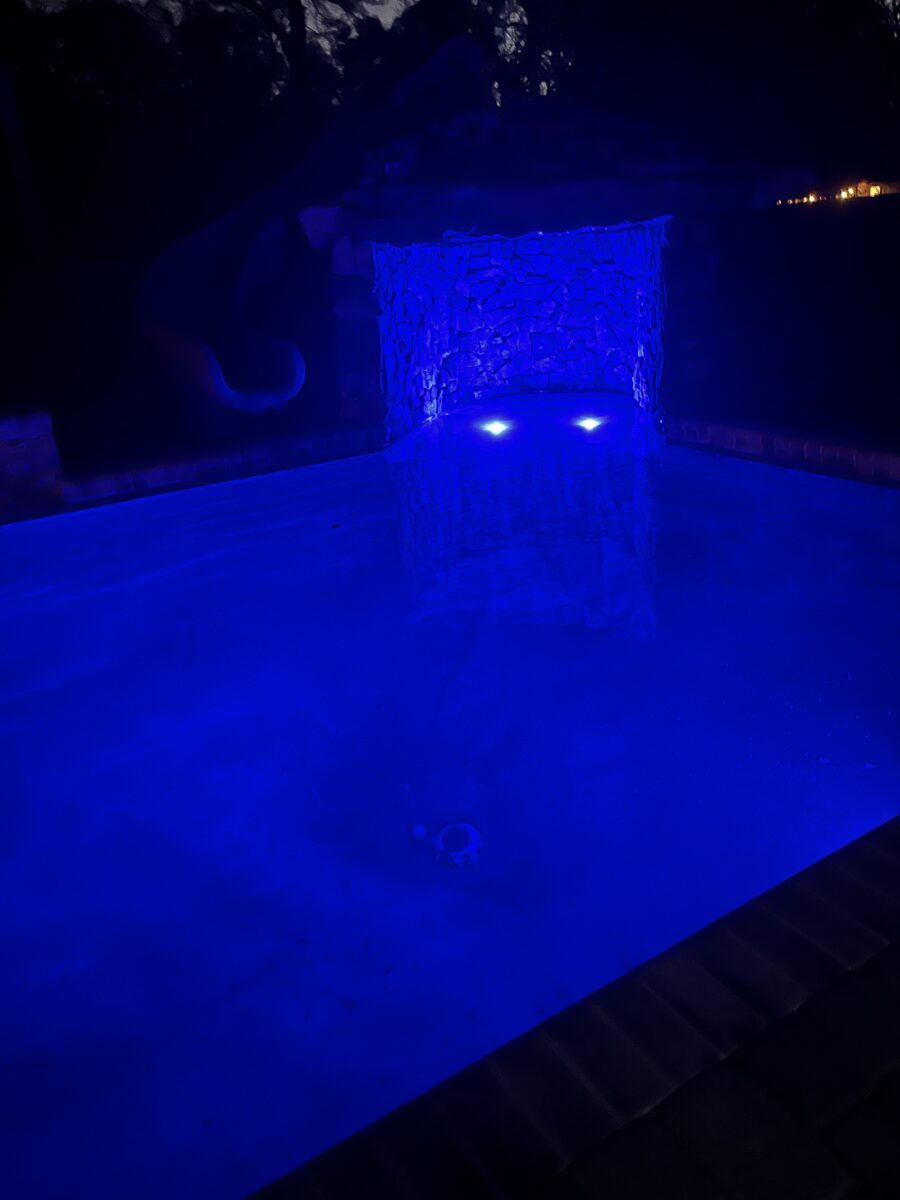
Your pool can look beautiful from the patio while the steps disappear in shadow. Comparing pool lighting options starts with visibility, not color shows, and LED is the best starting point for most new inground pools in Gainesville and Alachua County.
Compare your main pool lighting options
Choose lighting for nighttime swimming first, then add decorative effects. North Florida’s long swim season gives you plenty of opportunities to use both.
| Lighting type | Underwater visibility | Decorative effects | Upfront cost factors | Controls | Replacement needs |
|---|---|---|---|---|---|
| LED | Main illumination | White or changing colors | Fixtures, wiring, controls | Switch or compatible automation | Bulb or complete fixture |
| Fiber optic | Verify proposed system | Perimeter and sparkle effects | Engine, cables, routing | Engine-specific | Engine and cable support |
| Halogen | Existing-pool illumination | Usually fixed color | Fixture and conversion scope | Typically switching | Bulb and fixture condition |
| Floating or solar | Not primary illumination | Surface accents | Accessory purchase | Product-specific | Batteries or complete accessory |
LED pool lights: the best starting point
White LEDs suit straightforward evening swimming. Color-changing LEDs add atmosphere, but check the actual white setting before paying for effects. Attractive blue water does not necessarily mean clearly visible steps.
Larger fixtures generally use recessed housings called niches. Smaller nicheless lights fit purpose-built wall fittings without traditional recessed housings, offering different placement possibilities rather than automatic compatibility.
LEDs generally use less electricity than halogen for comparable useful illumination. Compare exact manufacturer wattage, beam data, and rated life instead of relying on blanket savings claims. Rated life estimates how long a light source may operate; warranty coverage is a separate promise with conditions and exclusions.
Fiber optic pool lighting: a specialty choice
A fiber-optic system uses a remote light engine to send light through cables to endpoints, rather than placing an electrical light source at each underwater endpoint.
Treat perimeter accents and sparkle effects separately from underwater illumination. Before comparing brightness, price, or installation complexity with LED, require current manufacturer documentation for the proposed system.
Your estimate should identify cable routes, accessible light-engine placement, and available replacement support. Electrical components still exist at the engine, so fiber optics should not be presented as automatically safer.
Halogen, floating, and solar lights: know the limits
Halogen belongs in an existing-pool evaluation, not as the default for a new build. Compare retaining the existing fixture with an approved LED conversion.
Floating and solar-powered lights are decorative extras, not substitutes for planned underwater visibility. Return-jet and skimmer lights, often marketed for above-ground pools, also are not interchangeable with purpose-built inground fixtures.
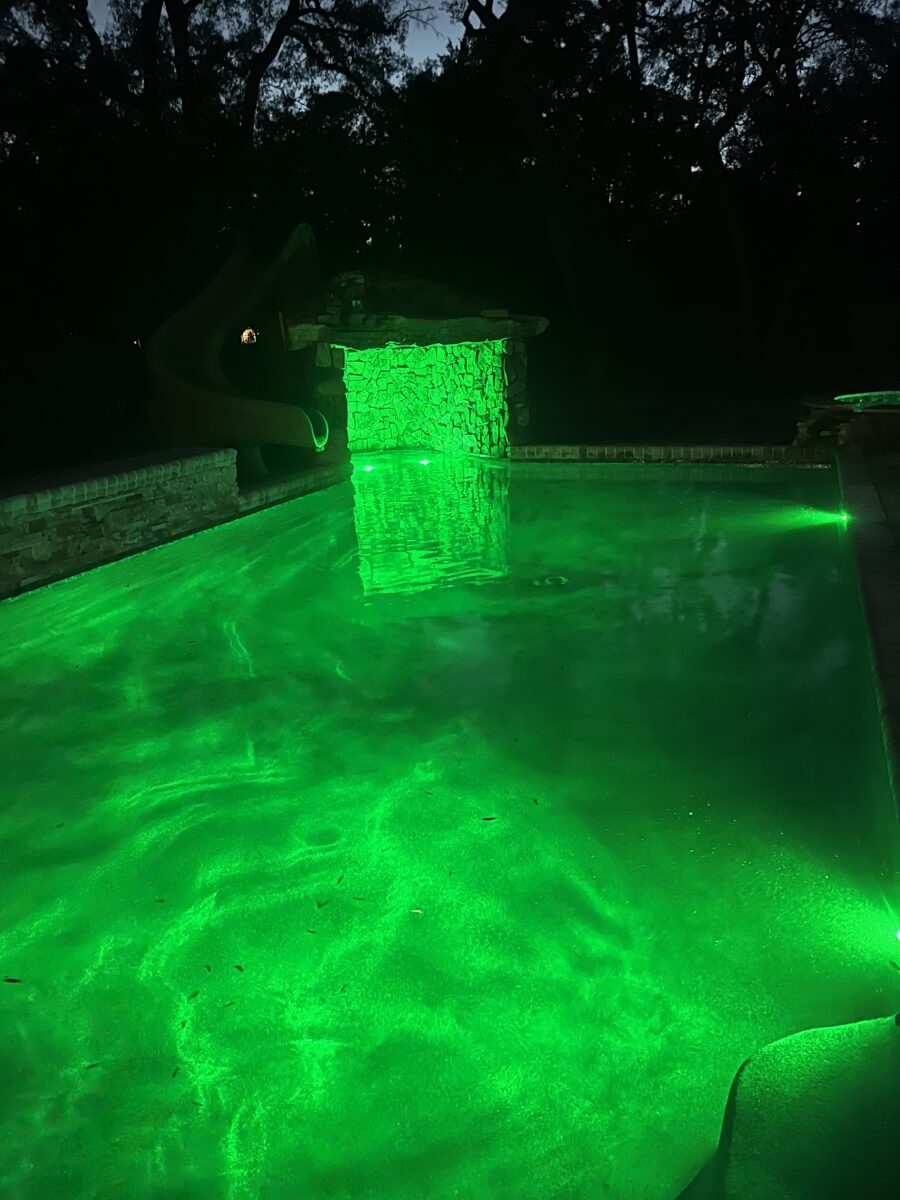
Plan where the light goes before choosing fixtures
Fixture count alone cannot tell you whether your swimming pool will be well lit. Beam spread, overlapping coverage, wall angles, and depth changes determine where useful light reaches.
Steps and benches can cast shadows even when the center looks bright. Aim fixtures away from your main seating area and house windows where practical, reducing the bright spots that make looking toward the pool uncomfortable.
Your finish matters, too. Dark surfaces absorb more light, while pale finishes reflect more. Water appearance changes with the finish and lighting color, and saturated color settings can make edges and depth changes harder to distinguish. Evaluate visibility in white mode.
Walk through a 15-by-30-Foot pool layout
For a hypothetical rectangular pool in Jonesville, picture shallow-end steps, a sun shelf, and a deep end. A starting concept could place wall-mounted LEDs along the patio-side wall, aimed across the pool and away from your main seating view.
Assess overlapping beams through the swimming area, then check whether the steps block light and whether the shelf needs dedicated illumination. If you are planning a shallow lounging area, include that feature in the lighting sketch from the start.
An illustrative layout with two LEDs is not a fixture-count rule. Actual beam specifications, geometry, depth, and finish color must determine the final arrangement.
Decide which lighting upgrades are worth paying for
Spend on usable white light and even coverage before decorative effects. At a leaner budget, white-only LEDs and simple switching keep the scope focused. A middle-budget plan can add color; a higher-budget plan can add coordinated controls and separate lighting zones.
Compatibility matters more than a long feature list. A separate remote may be enough, while integrated controls make sense when you also want coordinated pump, spa, and lighting operation. Check how connected pool controls work before adding another app.
For the surrounding outdoor space, combine underwater lighting with deck, path, and planting-area lighting. Overhead string lights provide atmosphere, not underwater visibility, and need appropriate placement and electrical design near water.
Avoid buying extra brightness to compensate for poor placement, adding unsupported smart controls, or choosing color effects without checking white-light performance.
Match your lighting plan to your pool build or rebuild
Yes, you can add pool lights to an existing pool. Your available routes depend on construction, existing equipment, conduit condition, and access.
For a new pool, settle fixture locations and wiring routes before shell work and decking. During a rebuild, include lighting early in the estimate, when access and finish repairs can be coordinated.
If you are still deciding how much of an old pool to keep, assess lighting alongside the shell, finish, and equipment. Include the existing lights in your Swim State renovation scope at /pool-renovations/, rather than treating lighting as a last-minute accessory.
Choose between a bulb swap, fixture replacement, or new lights
A bulb swap works only when your fixture accepts a replaceable bulb and the replacement is approved for that application. A bulb advertised as “universal” is not enough.
A complete fixture replacement requires checks for niche compatibility, voltage, cord length, conduit condition, transformer capacity, and controls. Not every LED fits an existing niche.
Adding lights may require new fittings, conduit, electrical work, and finish repairs. In your Gainesville-area yard, sandy soil over limestone can affect excavation and routing, so access deserves attention before pricing.
Check compatibility with your Pool’s construction
Concrete, fiberglass, and vinyl-liner pools need construction-specific fittings and sealing details. Your shell material affects how a light opening is formed and sealed.
Traditional niches and nicheless fittings are not universally interchangeable. Above-ground lighting kits generally do not transfer directly to an inground project because mounting methods and approved applications differ.
Compare installed cost with the cost of ownership
A fixture price is not an installed price. Your estimate also needs transformers, controls, wiring, labor, access, permits, and any deck or finish restoration.
New-build installation can coordinate those components before surfaces are finished. A retrofit can involve tracing old conduit or reopening finished areas. Compare matching scopes rather than assuming a cheaper fixture produces a cheaper project.
When comparing payment plans, review Swim State’s financing information at /financing/ separately from the equipment decision. Focus on both total project cost and financing terms.
You can estimate lighting energy with:
Total watts ÷ 1,000 × operating hours × electricity rate
For example, two illustrative 20-watt fixtures running four hours nightly use 4.8 kWh over 30 days. At an illustrative $0.15 per kWh, that is $0.72, excluding transformer losses and other equipment.
Electricity savings alone do not establish payback. Check warranty terms, labor coverage, replacement access, proprietary controls, and whether a failed LED requires replacing the whole fixture.
Understand voltage, electrical safety, and local requirements
You may encounter 12-volt and 120-volt pool lighting. Neither belongs on a DIY electrical project.
Low-voltage fixtures need a suitable pool-lighting transformer and matching electrical specifications. Cable length and voltage drop, the reduction in voltage along a wire, affect system design. A 120-volt installation also needs equipment and protective measures appropriate to its approved application.
GFCI protection detects certain current leaks and interrupts power. Grounding provides a fault-current path; bonding connects designated conductive components to reduce voltage differences. Exact requirements depend on the system and applicable code.
Use a qualified, appropriately licensed professional and pool-listed equipment approved for the intended installation. An IP68 label describes resistance to water intrusion under specified conditions; that label alone does not establish suitability for a swimming pool.
Confirm permits, inspections, and adopted electrical requirements with the authority serving your address, whether the City of Gainesville, Alachua County, or another municipality. For planned neighborhoods such as Haile Plantation, check HOA approval requirements for visible exterior changes separately from permits.
Summer storms deserve a separate rule: lighting does not make storm swimming safe. Get out when you hear thunder, seek substantial shelter, and wait at least 30 minutes after the last thunder before returning.
Choose your best fit and bring it to your pool consultation
For uncomplicated nighttime swimming, start with white LEDs and careful placement. For swimming plus entertaining, consider color-changing LEDs with a useful white mode. Reserve specialty fiber optics for a clearly defined decorative effect supported by current system documentation.
For an existing pool, prioritize an approved, compatible LED upgrade over a promised quick swap. Decorative extras come after visibility and practical replacement access.
Request an itemized estimate covering:
- Proposed fixture locations
- Exact fixture models
- System voltage
- Compatible controls
- Complete installed price
- Written warranty terms
- Replacement access
- Permit responsibility
That information makes competing estimates easier to compare without guessing what “lighting package” includes.
Frequently asked questions
What is the best lighting for a pool area?
Use purpose-built underwater fixtures for swimming visibility and separate deck and path lighting for walking areas. White LEDs are a practical starting point; add color only after confirming useful coverage.
Can you add lights without rebuilding the entire pool?
Sometimes. A compatible replacement may use an existing fitting and conduit, while additional locations can require shell work, new electrical routes, and finish repairs. Have access and compatibility assessed before settling on a scope.
Are color-changing pool lights bright enough for swimming?
Potentially, but evaluate the exact model and layout. Check the white setting and visibility at steps, benches, and depth changes rather than judging brightness from promotional color photos.
Are solar lights enough for an inground pool?
Treat solar lights as decorative additions. Variable charging and accessory placement make solar lighting unsuitable as the basis of a planned underwater visibility system.
Can you control pool lights from your phone?
Yes, with compatible fixtures and controls. Confirm the proposed controller supports the exact lights, desired color functions, and scheduling features before purchasing equipment.
Mark your steps, sun shelf, and main seating view on a pool sketch, then bring it to a build or rebuild consultation for a lighting plan and itemized estimate. Start with the pool cost estimator or call Swim State at (352) 318-9782.